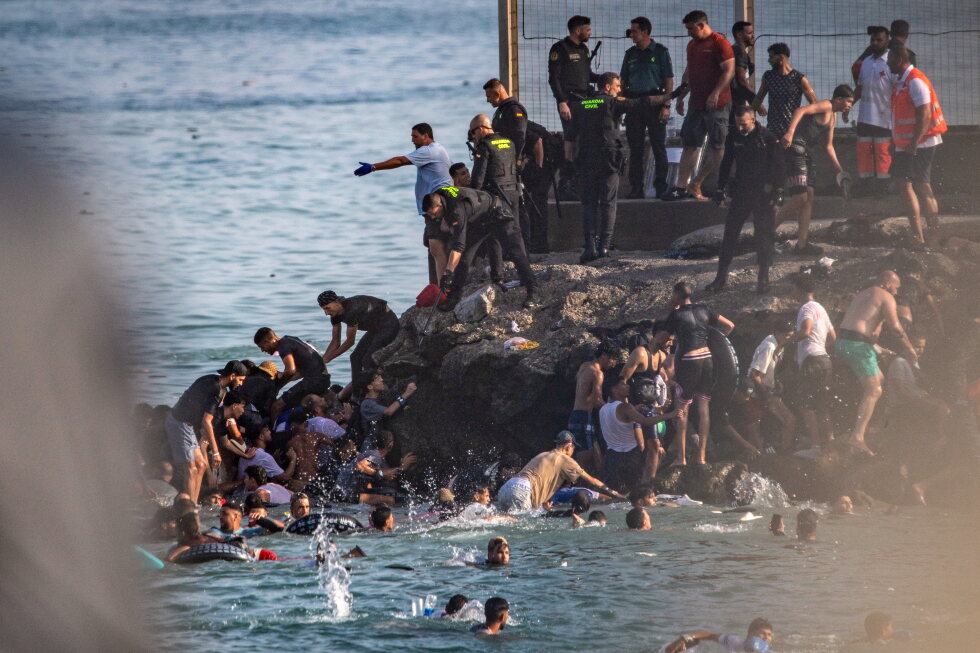
Spanish Military Deployed to Ceuta Amid Border Chaos
In response to a major border crisis with Morocco, Spain has announced the deployment of its military to the enclave of Ceuta. This decision follows the arrival of thousands of migrants into the Spanish territory, resulting in at least nine fatalities.
Local authorities in Ceuta had appealed to the central government in Madrid for assistance, leading to the reinforcement announcement. The Spanish government confirmed that the Armed Forces would collaborate with the Civil Guard to ensure stability in Ceuta. Prime Minister Pedro Sánchez, alongside Interior Minister Fernando Grande-Marlaska, planned to assess the situation firsthand with a visit to the area.
Rachid Sbihi, who heads the association representing Spain’s Civil Guard in Ceuta, described the situation as “absolute chaos,” noting that the border had “totally collapsed.” He emphasized the difficulty in providing precise numbers of migrants crossing.
Achraf Maimouni from the Moroccan Association for Human Rights labeled the events as “exceptional,” commenting on the unusual opening of the Tarajal border that allowed numerous individuals to enter.
Footage captured large groups, primarily Moroccans, making their way around Tarajal beach’s breakwaters and onto local roads. While the majority appeared to be young men, families with women and children were also seen. Some migrants expressed their sentiments by exclaiming “Viva España!” to a freelance photographer on the scene. The exact motivations behind the mass crossings remain uncertain.
Increasing Numbers and Unclear Motivations
The recent surge at the Spain-Morocco border follows a notable increase in migrants attempting to reach Ceuta, many opting for the perilous swim from Morocco. Moroccan authorities have remained silent on the crossings, and official comments from Morocco’s Interior Ministry are yet to be received.
Despite the lack of formal statements, Spain’s Interior Ministry acknowledged Morocco’s cooperation in managing the situation. Discussions between the two nations aim to facilitate the swift return of individuals who entered Ceuta illegally.
Although local authorities in Ceuta requested a national emergency declaration due to migration concerns, the Spanish government did not concur. Nonetheless, the ministry assured the public of its commitment to national security and border integrity.
Elsewhere in Europe, the events in Ceuta prompted a response from Italy. Premier Giorgia Meloni hinted at suspending Italy’s Schengen agreement with Spain, emphasizing the need to protect national borders and citizen safety.
Some authorities in Ceuta attributed the migrant influx to a recent Spanish Supreme Court decision, which prohibits the immediate return of sea-arriving migrants without due process. However, this ruling does not pertain to land entries, such as those over the border fence. Critics in Morocco questioned the ruling’s influence, suggesting many migrants might be unaware of the legal change.
Ceuta, a key entry point for migrants seeking improved economic opportunities in Europe, has seen numerous attempts by individuals to reach its shores. Migrants often swim from the Moroccan towns of Fnideq and Belyounech, covering distances of 3.1 miles (5 kilometers) and shorter, respectively.
This situation recalls a previous border crisis in May 2021, where over 8,000 migrants entered Ceuta within a two-day span. The 2021 incident was linked to diplomatic tensions between Spain and Morocco, following Spain’s medical assistance to Brahim Ghali, leader of the Polisario Front, which Morocco opposes.
Call for National Emergency and Military Assistance
Amid the escalating crisis, Juan Jesús Vivas, the leader of Ceuta’s regional government, urged the national government to declare an emergency for national security reasons. He requested additional police and military presence to secure the border and ensure public safety.
Vivas highlighted the overcrowding in migrant reception centers, with hundreds forced to sleep on the streets following the entry of over 1,500 individuals in a week, and more crossing subsequently.
While the Interior Ministry did not confirm the exact number of recent arrivals, it plans to release updated migration data on August 3. As of mid-July, roughly 3,000 migrants had entered Ceuta by land or sea this year.
According to the ministry, existing legislation does not classify migration flows as a national security threat, but government agencies are coordinating to address the situation in Ceuta effectively.
Ceuta, a Spanish territory since 1580, is situated on a strategic isthmus and houses a diverse population of Christians and Muslims, Spanish and Moroccan residents, and day workers, all living in relative harmony behind its border fence.