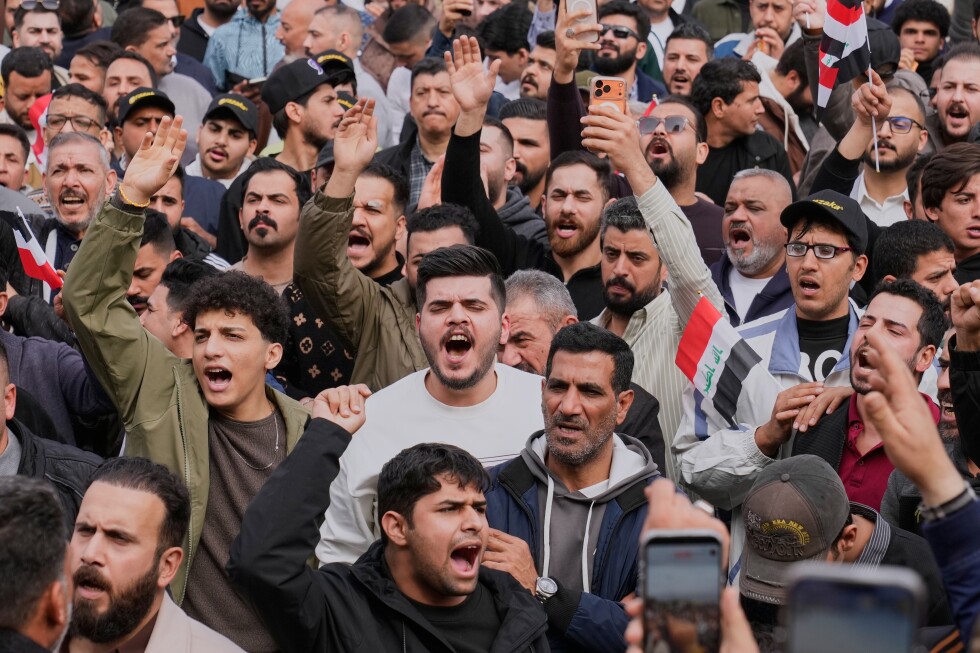
Protests Erupt in Baghdad Over New Customs Tariffs
In the heart of Baghdad, a significant protest unfolded on Sunday involving hundreds of traders and customs clearance company owners. The demonstrators voiced their discontent with the recently introduced customs tariffs, urging the Iraqi government to retract these measures that have reportedly escalated their operational expenses and disturbed trade activities.
Implemented on January 1, the new tariffs are part of a broader strategy to mitigate Iraq’s national debt and lessen its dependency on oil revenues amid declining oil prices. Iraq’s economic framework continues to rely heavily on oil, accounting for approximately 90% of the state’s revenues. The country is currently grappling with a debt exceeding 90 trillion Iraqi dinars, equivalent to $69 billion.
Traders are particularly aggrieved by the tariffs, which have soared to as much as 30% in certain instances, placing what they perceive as an undue financial strain on their businesses. A legal challenge has been mounted against these tariffs, with Iraq’s Federal Supreme Court scheduled to deliver a verdict on the matter on Wednesday.
Outside the General Customs Directorate, protesters chanted against corruption and expressed their opposition to the heightened fees. Haider al-Safi, a transport and customs clearance company owner, highlighted the financial impact, stating, “We used to pay about 3 million dinars per container, but now in some cases they ask for up to 14 million.” He also noted a sharp increase in fees for infant milk, rising from approximately 495,000 dinars to nearly 3 million.
Al-Safi further reported a congestion of goods at the Umm Qasr port in southern Iraq, attributing it to the new tariffs. He pointed out that electric vehicles, which previously enjoyed exemption from customs duties, now incur a 15% fee.
Adding to the discourse, Mohammed Samir, a wholesale trader from Baghdad, emphasized the economic repercussions on everyday citizens. “The main victim is the citizen with limited income, and government employee whose salary barely covers his daily living, those who have to pay rent, and have children with school expenses — they all will be affected by the market,” he stated.
Protesters also leveled accusations of corruption, alleging that influential groups are facilitating the release of goods in return for lower unofficial payments. Many traders are contemplating rerouting their imports through the Kurdistan region, where customs fees are reportedly more favorable.
The protests occurred alongside a nationwide strike by shop owners, who shuttered markets and stores across several parts of Baghdad in opposition to the tariff hikes. In key commercial areas, shops remained closed, displaying banners with slogans such as “Customs fees are killing citizens.”