France and Global Leaders Recognize Palestinian Statehood Amid Gaza Conflict
As hostilities persist in Gaza, France has taken a significant step by recognizing Palestinian statehood during a United Nations meeting aimed at reinforcing the two-state solution to the long-standing Mideast conflict. This move, announced by French President Emmanuel Macron, was met with applause from over 140 leaders present at the U.N. General Assembly, despite opposition from Israel and the United States.
“True to the historic commitment of my country to the Middle East, to peace between the Israelis and the Palestinians, this is why I declare that today, France recognizes the state of Palestine,” Macron stated, drawing a standing ovation from the Palestinian delegation.
Following France’s lead, several European nations including Andorra, Belgium, Luxembourg, Malta, and Monaco also recognized or reaffirmed their recognition of a Palestinian state. This decision follows similar announcements by the United Kingdom, Canada, Australia, and Portugal. However, Germany, Italy, and Japan, while attending the conference, did not extend recognition.
The U.N. assembly and the wave of recognitions are unlikely to alter the immediate conditions on the ground, where Israel is actively engaged in a military campaign in Gaza and continues to expand settlements in the West Bank.
Palestinian President Mahmoud Abbas Calls for End to Violence
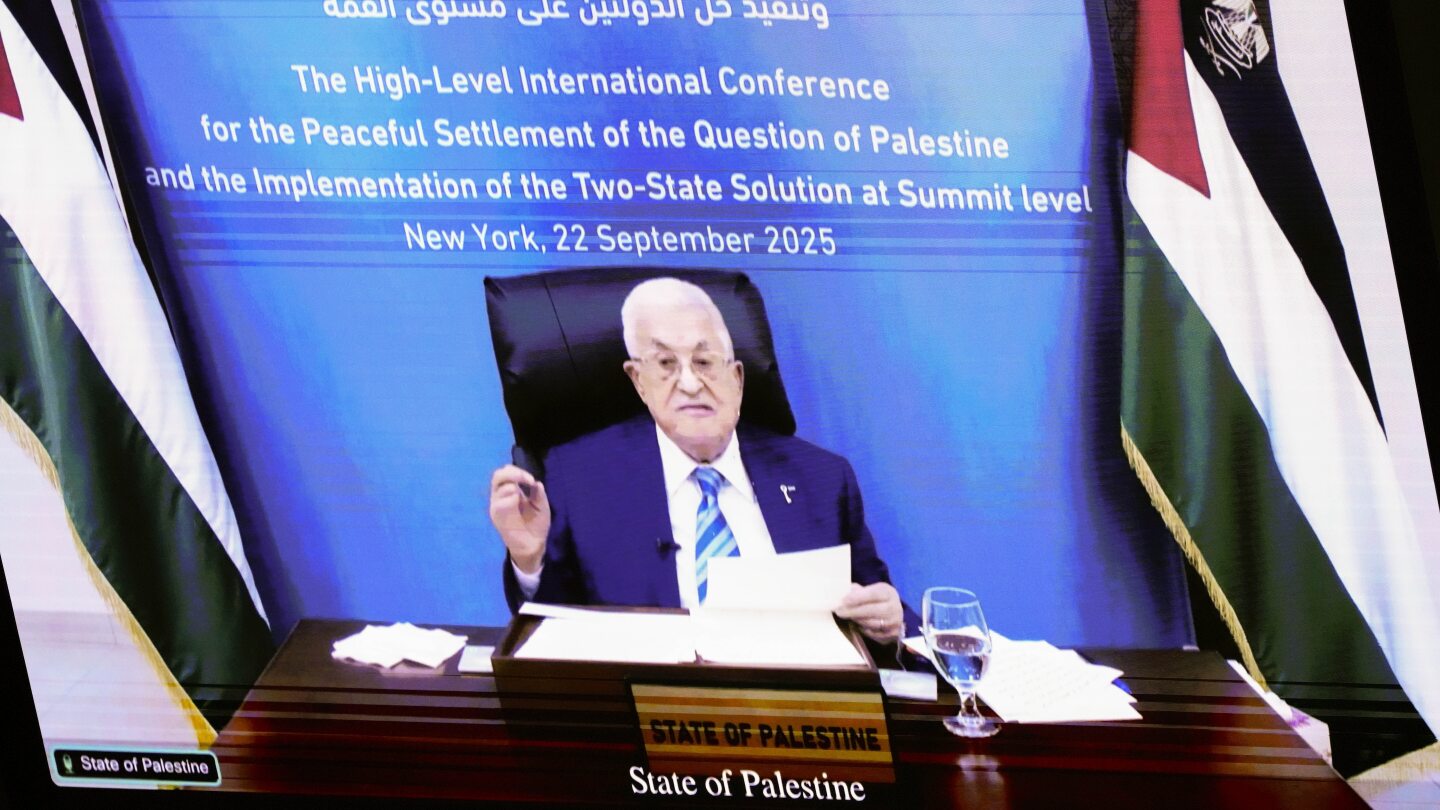
Palestinian President Mahmoud Abbas, addressing the assembly via video after the revocation of his U.S. visa, condemned the violence, including recent actions by Hamas. He highlighted the Palestinian Authority’s new social welfare system, which replaces payments to families of Palestinians affected by conflict, a previous point of contention with Israel and the U.S.
Addressing Israelis, Abbas called for an end to violence and extended wishes for a peaceful Rosh Hashana. The Palestinian Authority, recognized internationally, governs parts of the West Bank and remains committed to a two-state solution, despite Israeli accusations of incitement and exclusion from postwar Gaza plans.
International Recognition and Its Implications
Currently, approximately three-fourths of U.N. member states recognize Palestine, though major Western powers have historically withheld recognition, advocating for a negotiated resolution with Israel. Palestinians welcome these developments, viewing them as potential steps toward eventual independence.
The global consensus favors a Palestinian state alongside Israel encompassing territories acquired by Israel in the 1967 war. This is seen as a viable path to resolving the century-old conflict, exacerbated by Hamas’ recent attacks.
Israeli Opposition to Palestinian Statehood
Israeli Prime Minister Benjamin Netanyahu’s government maintains staunch opposition to recognizing Palestinian statehood, arguing it rewards Hamas. Netanyahu has suggested possible unilateral actions, such as annexing parts of the West Bank, which could further complicate the establishment of a Palestinian state.
Despite these challenges, U.N. spokesman Stephane Dujarric emphasized the need for perseverance in pursuing a two-state solution, undeterred by external threats.
Netanyahu faces pressure from his coalition to proceed with annexation plans. The United Arab Emirates, a key player in the 2020 Abraham Accords, considers this a “red line,” potentially affecting its diplomatic ties with Israel.
Netanyahu plans to discuss Israel’s response to the Palestinian statehood push with U.S. President Donald Trump, with whom he has had several meetings since Trump’s return to office. Both leaders oppose the growing international recognition of a Palestinian state, attributing it to stalled ceasefire negotiations with Hamas.
Fragmented Palestinian Politics and Ongoing Challenges
France and Saudi Arabia have proposed a phased plan for a reformed Palestinian Authority to govern the West Bank and Gaza, supported by a significant U.N. vote. However, Hamas, which won the last Palestinian elections, remains officially committed to a state encompassing all territory between the Mediterranean and Jordan River, including Israel.
Efforts for peace have historically faltered due to violence and Israel’s settlement expansion. Proponents of a two-state solution argue that without a Palestinian state, Israel risks maintaining a status quo of military occupation or evolving into a binational state lacking a Jewish majority.