Market Reaction to Federal Reserve’s Economic Projections
U.S. stock markets experienced a significant downturn on Wednesday following the Federal Reserve’s latest announcements. The S&P 500 declined by 2.9%, nearing its largest drop this year, as it distanced itself from its recent peak. The Dow Jones Industrial Average fell by 1,123 points, or 2.6%, while the Nasdaq composite saw a decrease of 3.6%.
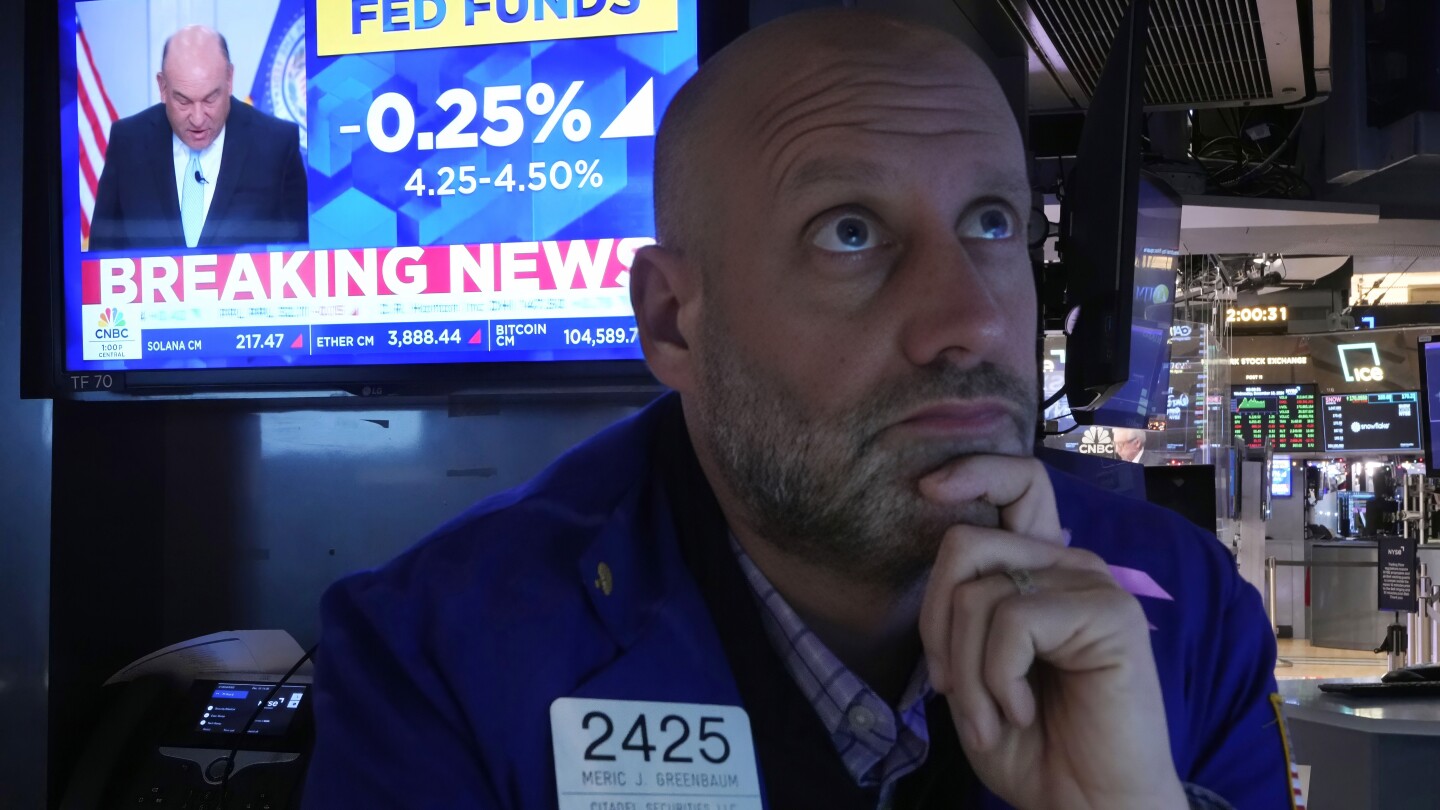
The Federal Reserve revealed it is reducing its main interest rate for the third time this year, continuing efforts initiated in September to lower rates from a 20-year high. This move aims to bolster the job market, a development generally welcomed by Wall Street. However, the market’s focus is shifting to the extent of the rate cuts expected next year. Earlier projections had anticipated a series of cuts in 2025, which aided the U.S. stock market in reaching record highs 57 times in 2024.
According to updated forecasts, the Federal Reserve now anticipates two more rate reductions in 2025, a half-percentage-point decrease, contrary to the four cuts expected three months prior. “We are in a new phase of the process,” stated Fed Chair Jerome Powell, highlighting the rapid easing of the central bank’s main interest rate to a range of 4.25% to 4.50% since September.
Powell explained that the decision to slow the rate cuts stems from a strong job market and recent upticks in inflation, alongside uncertainties that necessitate adaptive policymaking. Lower interest rates can stimulate economic growth by reducing borrowing costs and increasing investment values, but they also pose the risk of inflating prices.
Some Fed officials are considering the potential impacts of a new administration, led by President-elect Donald Trump, that might favor tariffs and other policies possibly exacerbating inflation and economic growth. “When the path is uncertain, you go a little slower,” Powell compared it to navigating in poor visibility conditions.
Among the Federal Reserve’s ranks, Cleveland Fed President Beth Hammack was the sole dissenter, opposing the recent rate cut. The reduction in anticipated 2025 rate cuts led to a rise in Treasury yields, putting pressure on the stock market. The yield on the 10-year Treasury increased to 4.51% from 4.40%, while the two-year yield rose to 4.35% from 4.25%.
Stocks sensitive to rising interest rates suffered some of the greatest losses, with smaller companies particularly affected due to their reliance on borrowing for growth. The Russell 2000 index of small-cap stocks dropped 4.4%.
In corporate news, General Mills saw a 3.1% decrease despite reporting higher-than-expected quarterly profits. The company plans to boost investments in its brands, leading to a revised, lower profit forecast for the fiscal year. Nvidia, a key player in Wall Street’s recent rallies, continued its decline, dropping 1.1% and losing over 13% from its record high last month.
Conversely, Jabil experienced a 7.3% rise, driven by stronger-than-expected profit and revenue reports, and an upgraded revenue forecast for the fiscal year.
Overall, the S&P 500 fell by 178.45 points to 5,872.16, the Dow Jones Industrial Average decreased by 1,123.03 to 42,326.87, and the Nasdaq composite dipped by 716.37 to 19,392.69.
Internationally, London’s FTSE 100 saw a minor increase of less than 0.1% following data showing inflation rose to 2.6% in November, its highest in eight months. The Bank of England is set to announce its interest rate decision later this week. In Japan, the Nikkei 225 fell 0.7%, despite a 23.7% surge in Nissan Motor Corp. shares amid discussions of closer collaboration with Honda Motor Co., though no merger decision has been made.
Nissan, along with Honda and Mitsubishi Motors Corp., agreed in August to collaborate on electric vehicle components and autonomous driving software development to better adapt to the automotive industry’s rapid changes.